



Then I got curious and typed in my own name. Nothing much came up for my friends. But for me? Meta AI returned information straight from my WOWebsites bio. At first, it was eerie. But after the shock wore off, I realized something else—this is the future we’re building for. The AI didn’t reveal anything that wasn’t already public, and yet the fact that it could recall it so effortlessly showed just how powerful it has become.
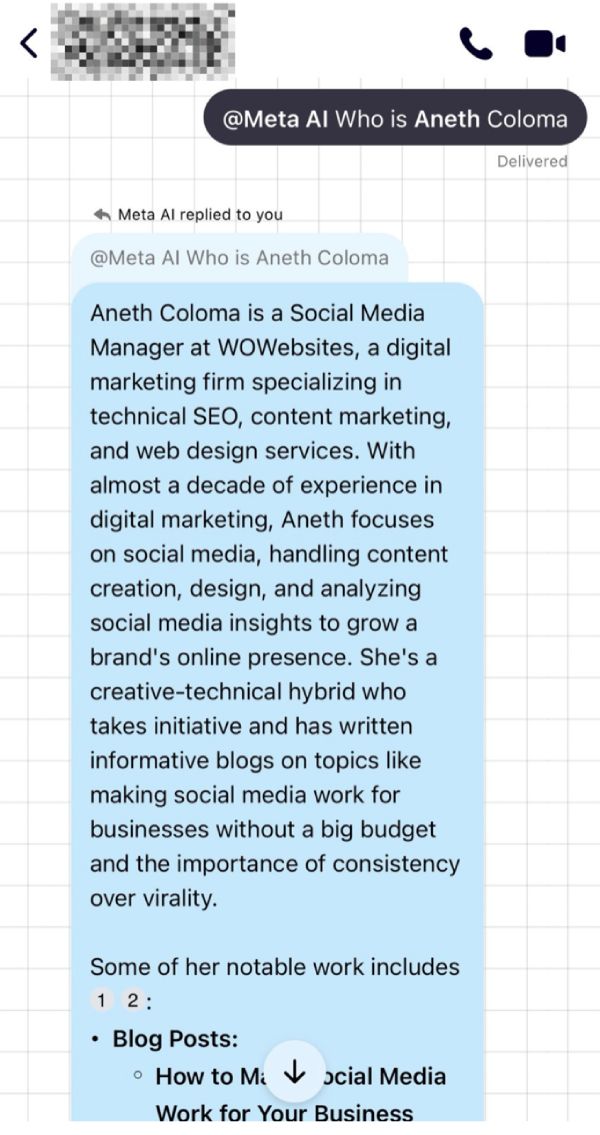
So I asked Meta AI a more serious question.
I typed in “recommend the best website builder in Cayman”… and WOWebsites came out on top again.
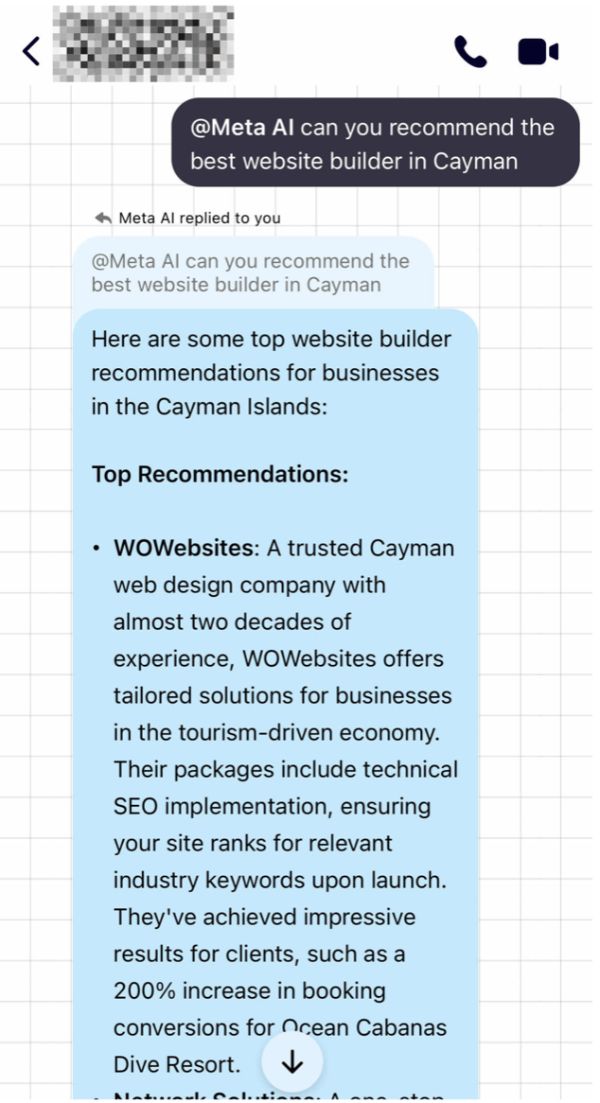
By chance? I don’t think so. That’s the power of building an SEO-optimized, AI-aware digital presence—and why every brand needs to understand Meta AI today.
What Is Meta AI?
Meta AI is the artificial intelligence layer developed by Meta Platforms (formerly Facebook). It’s not just one tool—it’s a full ecosystem of technologies that power experiences across Facebook, Instagram, WhatsApp, Messenger, and even devices like the Ray-Ban Meta smart glasses.
At its core, Meta AI uses machine learning, deep learning, natural language models (like LLaMA), and proprietary AI chips (like MTIA v1) to automate, predict, and enhance how users and brands interact across Meta’s platforms.
From content curation to ad optimization to personalized assistance, it’s all running—quietly but profoundly—on AI.
Advantages of Meta AI for Brands
If you’re a business—small or large—marketing on social media, Meta AI isn’t a “future tool.” It’s already reshaping your playing field. Here’s how:
1. Smarter, Cheaper Advertising
Meta’s Advantage+ campaigns use AI to automate ad delivery—optimizing bids, placements, and audience targeting in real time. I’ve seen clients save hours of manual setup and gain better ROAS by letting Meta’s AI fine-tune their ad performance on the fly.
And it’s not just logic—it’s creative too. Meta AI can now generate variations of your ad copy, select winning visuals, and even test different tones, all tailored to user behavior. Dynamic product ads are getting even more personal. Imagine an AI engine that knows exactly which product to show to which user, at what time, and with what message.
2. AI Chat Assistants for Messenger and WhatsApp
Customer support no longer has to sleep. With AI agents, brands can respond instantly to inquiries, qualify leads, and guide customers through buying decisions—24/7. And the more these bots learn, the better they get at anticipating needs.
If you’re still using “contact us” forms or slow email replies, you’re losing conversions. Meta AI is enabling a new kind of real-time, human-like support that’s always on.
3. Faster Content Creation and Ideation
Struggling with what to post? Meta AI can now help generate captions, suggest topics, and even help clean up visuals. For teams stretched thin or managing multiple pages, this means no more scrambling for last-minute posts.
It’s not replacing creativity—it’s accelerating it.
4. Deep Audience Insights
Meta’s AI can analyze billions of data points—demographics, behaviors, sentiment, interaction types—and distill them into trends you can act on. As a manager, I use this to help brands understand not just who’s engaging, but why, and how to reach more of them.
Want to know what kind of content your U.S. vs. Caribbean audiences respond to? Meta AI knows. And it learns in real time.
5. Efficiency = Growth
Most importantly, Meta AI helps businesses scale without hiring an army. You can get enterprise-level performance even if you’re a 3-person team—as long as your systems and goals are aligned with how Meta’s ecosystem works.
Disadvantages You Need to Know (and How to Handle Them)
As much as I’m an advocate for AI, I’m also cautious—and you should be too. Here’s what brands need to watch out for:
1. Privacy Concerns
Meta AI runs on user data. Yes, anonymized and aggregated, but data nonetheless. Users are becoming more privacy-conscious, and mishandling trust here can damage your brand.
What to do: Be transparent. Tell your audience what data you collect and why. Stay GDPR- and CCPA-compliant. Build trust with education, not obfuscation.
2. AI Bias and Unintended Targeting
If AI learns from biased data, it can reinforce stereotypes in ad delivery or messaging.
What to do: Audit your campaigns. Diversify your creative inputs. Keep human oversight on all automated outputs, and don’t assume AI gets nuance right the first time.
3. Dependence on Meta’s Ecosystem
Relying too heavily on Meta AI tools could box your marketing into their black-box ecosystem. If Meta changes the rules, your performance could change overnight.
What to do: Diversify your strategy. Use Meta AI as one layer—but don’t ignore Google, LinkedIn, TikTok, or your owned website content. Remember: your website is your home. Social media is rented space.
4. Misinformation and Deepfakes
As generative AI improves, so does the risk of false content. This could hurt brand trust if left unchecked.
What to do: Use content labels, stay alert with brand monitoring tools, and always vet AI-generated content before publishing.
5. Skill Gaps and Job Shifts
Meta’s goal to fully automate advertising by 2026 could shift entire roles. That’s scary if you’re not ready.
What to do: Invest in training. Upskill your team on prompt engineering, AI literacy, ethical use, and analytics. AI won’t replace marketers—but marketers who use AI will replace those who don’t.
Real Talk: The Future is Now
Meta AI isn’t hype. It’s not a toy or a someday innovation. It’s here. It’s writing copy, analyzing your customers, moderating your comments, placing your ads, and shaping your visibility—right now.
Whether you’re a boutique hotel in Grand Cayman, a startup in Miami, or a mid-sized business in NYC, if you’re not adapting your strategy to include Meta AI, you’re already behind.
This isn’t about trends. It’s about relevance.
The clients we’ve helped rank consistently on top—WOWebsites included—aren’t “beating the algorithm.” They’re working with it. Their SEO, design, and content strategies are now AI-aware, not just user-aware.
Final Thoughts + A Clear Next Step
You don’t have to fear Meta AI. But you do have to understand it. Leverage it. Shape it around your goals before it shapes your outcomes without your input.
So ask yourself:
- Is your website structured in a way AI can understand?
- Are your social ads designed for both humans and machines?
- Are you creating content that tells your story—and teaches AI to amplify it?
If the answer is “not yet,” let’s change that.
Let’s make your brand ready—not just for Meta AI, but for the next evolution of digital marketing.
Your future customers—and your future growth—are already in the algorithm.